
Published: 2026-05-14
2D vs 3D Custom Medals: What’s the Difference?
When designing custom medals for marathons, sports competitions, school awards, or corporate events, one of the biggest decisions is choosing between 2D and 3D custom medals. While both styles can look stunning, they offer very different visual effects, production methods, and pricing.
So, what exactly is the difference between 2D vs 3D custom medals? Which one is better for your event or brand?
In this guide, we’ll break down the differences in detail to help you choose the perfect medal style for your next project.
What Are 2D Custom Medals?
2D custom medals feature a design with raised and recessed metal layers but maintain a relatively flat surface. Different parts of the artwork are separated into levels, creating a clean and structured look.
For example:
- Logos are raised
- Text is elevated
- Background areas are recessed
- Colors are usually filled with soft enamel or hard enamel
The result is a medal with clear details and professional appearance without deep sculpting.
Key Features of 2D Medals
- Flat yet dimensional design
- Crisp lines and clean logo presentation
- Excellent for text-heavy designs
- Suitable for enamel color filling
- More affordable than 3D medals
Best Uses for 2D Medals
2D medals work especially well for:
- Running medals
- School awards
- Corporate recognition medals
- Charity event medals
- Sports competitions
- Dance or martial arts tournaments
If your design contains logos, event names, sponsors, or detailed text, 2D medals are often the best choice.
What Are 3D Custom Medals?
3D custom medals feature a more sculpted, realistic appearance. Instead of simple raised and recessed areas, the design includes curves, contours, shadows, and depth, creating a premium visual effect.
3D medals often look more artistic and luxurious because they resemble sculptures rather than flat metal pieces.
Examples of popular 3D medal designs include:
- Landmark buildings
- Mascots
- Character faces
- Animals
- Detailed sports figures
- National monuments
Key Features of 3D Medals
- Sculpted and realistic look
- Strong visual depth
- Premium and luxury appearance
- Better for artistic designs
- Eye-catching metallic finish
Best Uses for 3D Medals
3D medals are ideal for:
- Premium marathon medals
- Championship awards
- Commemorative medals
- Military challenge medals
- Tourism-themed medals
- Luxury event branding
If you want participants to say “wow” when they receive the medal, 3D designs usually create a stronger impact.
What Does a “2-Level Medal” Mean? 2D Terms Explained
“2D” and “2-level” describe the same thing, and the terms are often used interchangeably. A 2-level medal (also called a two-dimensional relief medal) has two distinct heights:
- Raised areas — logos, text and borders
- Recessed areas — the background
The raised surfaces are polished flat and rise at right angles to the background, so the medal still looks flat and structured when you view it from the side. The recessed background is normally textured with a darker antique finish, or color-filled with enamel. That contrast between polished raised metal and a darkened or colored background is what gives a 2-level medal its sharp, highly legible look.
The overall thickness of a standard 2-level medal is approximately 1/8″. Overall thickness is a separate decision from 2D vs 3D.
Flat vs Sculpted: How the Mold Is Engraved
A medal is always a physical, three-dimensional object — what actually differs between 2D and 3D is how the mold is engraved. Both 2-level and 3D medals are produced by die casting and die striking, but the mold work behind them is not the same.
- 2-level molds reproduce your artwork in two planes — concave and convex. Raised areas stay flat, edges rise cleanly, and preparing the mold is the least expensive option. This makes 2D ideal for inscriptions, logos and other graphics that do not need complex detail.
- 3D molds are sculpted or embossed rather than simply stamped, so raised areas come out rounded and lifelike instead of flat. Several depths can be built up so the layers create a striking “pop-out” effect — a soccer ball or baseball can rise out of the background as a curved dome, with fine detail such as dimples or stitches added on top.
That extra dimension is where the detail limit of 2D shows: a 2-level medal cannot present elements that demand heavy sculpting, such as faces, buildings or vehicles. Those designs need 3D — which is also why 3D medals tend to look more prestigious.
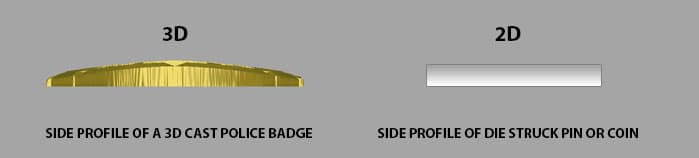
Side-Profile Cross-Sections
These cross-sections show the same designs seen from the side, where the difference is easiest to see:




The side profile below applies the same rule to a metal product: artwork that is engraved or stamped stays flat on the raised portions, while sculpted artwork reads as rounded and dimensional.
2D vs 3D Custom Medals: Main Differences
Here’s a direct comparison between the two styles:
| Feature | 2D Custom Medals | 3D Custom Medals |
|---|---|---|
| Surface | Mostly flat | Sculpted and curved |
| Visual Effect | Clean and professional | Premium and realistic |
| Detail Style | Simple raised levels | Deep dimensional artwork |
| Cost | More affordable | Higher production cost |
| Production Time | Faster | Slightly longer |
| Color Filling | Excellent for enamel | Usually less enamel used |
| Best For | Logo-based events | Artistic premium medals |
Which Medal Looks Better?
The answer depends on your event goals.
Choose 2D Custom Medals If:
You want:
- A lower production cost
- Fast turnaround time
- Clear branding and logos
- Bright enamel colors
- Bulk medal orders
For example, a 5K fun run medal with event logos and sponsors looks fantastic in 2D.
Choose 3D Custom Medals If:
You want:
- Premium visual impact
- Luxury appearance
- Sculpted artwork
- Collectible-style medals
- Unique event identity
For example, a city marathon medal featuring famous landmarks often looks more impressive in 3D.
Can You Combine 2-Level and 3D Elements in One Medal?
Yes. Many modern custom medals mix both techniques in a single design:
- 2-level text and borders
- 3D mascots, landmarks or characters
- 3D runners or figures set against a 2-level background
This hybrid approach delivers excellent visual appeal while keeping costs under control, because only the focal element carries the more expensive sculpted tooling.
Cost Difference Between 2D and 3D Medals
One major factor is price.
Generally:
2D medals cost less because the mold is simpler and production is faster.
3D medals cost more because:
- Mold carving is more complex
- Artwork requires sculpting
- Production takes longer
- More polishing and finishing are needed
However, pricing also depends on:
- Medal size
- Thickness
- Material
- Plating finish
- Quantity ordered
- Packaging
For bulk orders, the price difference becomes more manageable.
Tooling is one reason for the gap. A 3D mold takes longer to engrave than a 2-level mold, and 3D set-up charges can be roughly double those of a comparable 2D design. Because production technology has improved, 3D tooling is no longer the obstacle it once was, and the extra visual impact often justifies the investment for a high-profile event.
Which Finish Works Best?
Both 2D and 3D medals can be customized with premium finishes such as:
- Matte gold
- Shiny gold
- Antique gold
- Matte silver
- Shiny silver
- Antique bronze
- Black nickel
- Dual plating
However, 3D medals often look especially stunning in antique finishes, because shadows highlight the sculpted details.
Meanwhile, 2D medals pair beautifully with bright enamel colors and shiny plating.
Can 2D Medals Be Converted Into 3D?
Yes.
A professional medal manufacturer can redesign a flat logo or concept into a 3D medal effect. This often involves:
- Adding contours
- Creating shadows
- Sculpting faces or buildings
- Increasing depth
At Miracle Custom, many clients start with a simple 2D sketch and later upgrade to a premium 3D medal design.
Which Style Is Better for Running Events?
For most local running events and charity races, 2-level medals offer the best balance between quality, durability, cost and production speed.
For major marathons or anniversary races, where the finisher medal is meant to be kept and displayed, 3D medals provide the premium experience participants are proud to show off.
How to Choose the Right Medal Style
Ask yourself these questions:
1. What is your budget?
If budget matters most, go with 2D medals.
2. Do you want a premium look?
If visual impact matters, choose 3D medals.
3. Is your design text-heavy?
Text and logos usually work better in 2D.
4. Is your medal meant to be collectible?
Commemorative medals often look better in 3D.
5. Are enamel colors important?
Choose 2D medals for vibrant color filling.
Final Thoughts
Both 2D and 3D custom medals offer unique advantages, and neither is universally better. The best option depends on your budget, event type, design complexity, and branding goals.
If you want a clean, affordable, colorful medal, go with 2D custom medals.
If you want a luxury, high-impact, collectible award, choose 3D custom medals.
The good news? A professional manufacturer can help turn your ideas into stunning medal designs in either style.
At Miracle Custom, we specialize in premium 2D and 3D custom medals for marathons, sports events, schools, and businesses worldwide.
Need help choosing between 2D and 3D medals? Contact Miracle Custom for a design consultation today.
